
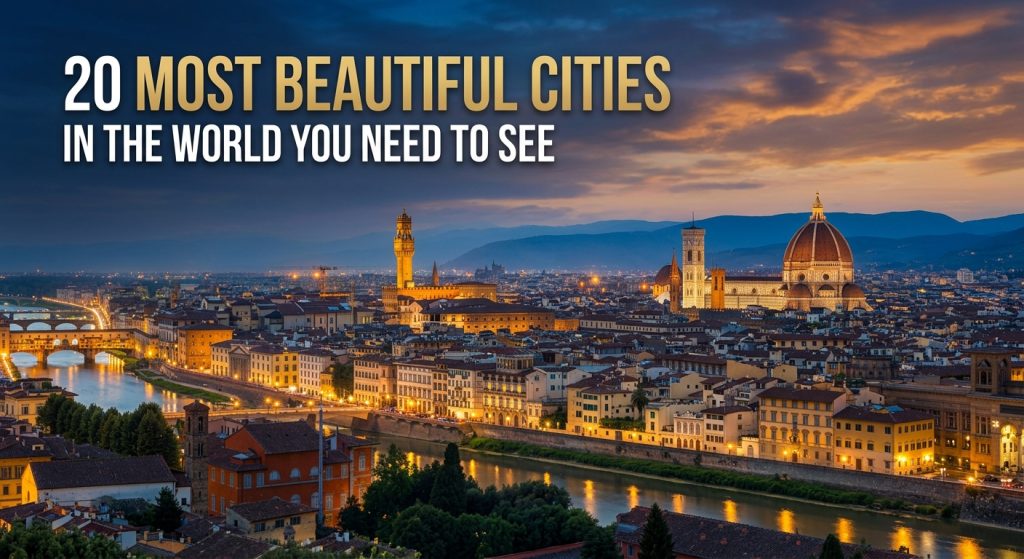
Some cities are beautiful because of a single postcard-famous landmark. Others earn the title through something harder to bottle — the way light falls on old stone in the late afternoon, the rhythm of canals or hills or coastlines woven into daily life, the layers of history visible on every street corner. This list isn’t just about pretty skylines. It’s about cities where beauty is part of the everyday experience, not just a backdrop for photos.
We’ve pulled together 20 destinations from every inhabited continent, each earning its place for a different reason — architecture, natural setting, color, history, or simply an atmosphere that’s impossible to replicate anywhere else. Here they are, in no particular ranking, because comparing Kyoto to Cape Town is a bit like comparing two different art forms.
1. Venice, Italy
No list of beautiful cities is complete without Venice, and for good reason. A city built entirely on water, with no cars and no straight roads, Venice forces you to slow down. Gondolas drift beneath centuries-old bridges, the facades of palazzos reflect in the canals, and St. Mark’s Square remains one of the most striking public spaces in the world. Visit early in the morning before the crowds arrive to see the city at its most magical.
2. Kyoto, Japan
Kyoto is Japan’s cultural heart, home to over a thousand temples and shrines, from the golden Kinkaku-ji to the endless vermillion gates of Fushimi Inari Taisha. What makes Kyoto genuinely beautiful, though, is the seasonal transformation — cherry blossoms in spring, deep green in summer, fiery maple leaves in autumn, and quiet snow-dusted temples in winter. Few cities anywhere balance tradition and tranquility this well.
3. Cape Town, South Africa
Framed by Table Mountain on one side and the Atlantic Ocean on the other, Cape Town might be the most dramatically situated city on Earth. Colorful Cape Dutch and Victorian architecture lines the streets of Bo-Kaap, while the coastline stretching toward the Cape of Good Hope offers some of the most striking ocean views anywhere. Few cities pair urban energy with raw natural beauty quite like this one.
4. Prague, Czech Republic
Prague’s Old Town looks almost untouched by time — Gothic spires, baroque facades, and the astronomical clock all sit within walking distance of one another. The Charles Bridge, lined with statues and crossing the Vltava River, connects the castle district to the historic center, offering some of the most photographed sunset views in Europe.
5. Rio de Janeiro, Brazil
Rio’s beauty comes from its setting as much as its city itself — lush green mountains rising directly behind golden beaches, with the Christ the Redeemer statue watching over it all from Corcovado. Sugarloaf Mountain, Copacabana, and the winding streets of Santa Teresa each offer a different angle on a city where nature and urban life are inseparable.
6. Santorini, Greece
Technically a collection of towns across a volcanic island, Santorini earns its place on nearly every “most beautiful” list for a reason. Whitewashed buildings with blue domed roofs cling to cliffs above the Aegean Sea, and the sunset views from Oia are so celebrated that crowds gather nightly just to watch the sky change color over the caldera.
7. Marrakech, Morocco
Marrakech is a sensory experience as much as a visual one, but its beauty is undeniable — the maze-like alleys of the medina, the intricate tilework of the Bahia Palace, and the gardens of Jardin Majorelle with their vivid cobalt blue walls. The city’s red-hued buildings glow especially warm at golden hour, giving Marrakech its nickname, the “Red City.”
8. Paris, France
Paris earns its reputation honestly. Beyond the Eiffel Tower, it’s the wide boulevards, the Haussmannian architecture with matching cream facades and wrought-iron balconies, and the way the Seine cuts through the city connecting Notre-Dame, the Louvre, and Montmartre. Paris rewards slow wandering — the city reveals itself best on foot.
9. Dubrovnik, Croatia
Dubrovnik’s massive stone walls encircle a red-roofed old town perched right on the Adriatic Sea, earning it the nickname “Pearl of the Adriatic.” Walking the city walls at sunset, with the sea on one side and terracotta rooftops on the other, remains one of the most striking urban walks anywhere in Europe.
10. Chefchaouen, Morocco
Tucked into the Rif Mountains, Chefchaouen is famous for its buildings painted almost entirely in shades of blue — a tradition believed to date back centuries. Wandering its narrow, steep streets feels like walking through a living watercolor painting, and the mountain backdrop only adds to the effect.
11. Cusco, Peru
Once the capital of the Inca Empire, Cusco combines Incan stonework with Spanish colonial architecture in a way found nowhere else. Sitting high in the Andes, the city’s terracotta rooftops spill down the hillsides, and its central plaza is framed by mountains on every side. It also serves as the gateway to Machu Picchu, making it as historically significant as it is beautiful.
12. Budapest, Hungary
Split by the Danube River into Buda and Pest, Budapest offers grand architecture on both sides — the neo-Gothic Hungarian Parliament Building, the hilltop Buda Castle, and thermal bathhouses dating back centuries. Crossing the Chain Bridge at night, with both riversides lit up, is one of Europe’s most underrated views.
13. Kyiv-adjacent Lviv, Ukraine
Lviv’s Old Town, a UNESCO World Heritage Site, is known for its blend of Gothic, Renaissance, Baroque, and Art Nouveau architecture packed into a compact, walkable center. Cobblestone squares, coffeehouse culture, and beautifully preserved churches make it one of Eastern Europe’s most visually rich cities.
14. Hallstatt, Austria
Hallstatt is small — more of a village than a city — but its beauty is so complete it deserves inclusion. Set on the edge of a still alpine lake and backed by dramatic mountains, its pastel houses seem to rise directly out of the water. It’s the kind of place that looks almost too perfectly composed to be real.
15. Istanbul, Turkey
Straddling two continents, Istanbul’s skyline of domes and minarets — the Hagia Sophia, the Blue Mosque, Topkapi Palace — rises above the Bosphorus Strait, where Europe and Asia are separated by only a narrow stretch of water. Few cities carry this much layered history, from Byzantine to Ottoman, this visibly on their streets.
16. Bruges, Belgium
Bruges’ medieval center, crisscrossed by canals and cobblestone streets, has changed remarkably little over centuries. Gothic guild houses line the main square, swans drift along the waterways, and the entire city feels like a preserved snapshot of Northern European history — quieter and more intimate than its larger neighbors.
17. Cape Coast to Zanzibar Stone Town, Tanzania
Stone Town’s narrow, winding alleys are lined with intricately carved wooden doors, a signature feature of Swahili coastal architecture. Blending Arab, Persian, Indian, and European influences, the city’s waterfront and rooftop views over the Indian Ocean make it one of East Africa’s most visually distinctive destinations.
18. Vancouver, Canada
Vancouver proves that modern cities can be just as beautiful as historic ones. Glass skyscrapers sit against a backdrop of snow-capped mountains and the Pacific Ocean, with Stanley Park’s forested trails just minutes from downtown. Few cities anywhere combine urban density with this much accessible natural beauty.
19. Jaipur, India
Known as the “Pink City” for the terracotta-pink hue of its old town buildings, Jaipur is a showcase of Rajasthani architecture — the honeycomb facade of Hawa Mahal, the imposing Amber Fort, and the City Palace complex. Its planned layout, unusual for a city of its age, adds a sense of order to its intricate, ornamental beauty.
20. Queenstown, New Zealand
Set on the shores of Lake Wakatipu and surrounded by the jagged peaks of the Remarkables mountain range, Queenstown offers a different kind of beauty — vast, dramatic, and defined almost entirely by nature. It’s proof that a city doesn’t need centuries of architecture to be breathtaking; sometimes the landscape alone is enough.
What Makes a City Truly “Beautiful”?
Looking across this list, a few common threads emerge. The most visually memorable cities tend to combine at least two of the following:
- A dramatic natural setting — mountains, water, or both (Cape Town, Rio, Queenstown, Hallstatt).
- Architectural consistency — a unified color palette or building style that gives the whole city a cohesive identity (Chefchaouen, Jaipur, Prague).
- Layered history — visible evidence of different eras and cultures coexisting on the same streets (Istanbul, Cusco, Lviv).
- Walkability — beauty that reveals itself best on foot, at a slow pace, rather than from a car window (Bruges, Venice, Paris).
Understanding these patterns can also help you spot future favorites — the next time you’re choosing a destination, look for cities that combine a striking natural backdrop with a well-preserved or distinctive architectural identity, and you’ll likely find somewhere just as memorable as the twenty above.
Tips for Experiencing These Cities at Their Best
- Visit at golden hour. Nearly every city on this list looks noticeably more beautiful in the hour after sunrise or before sunset, when light is warm and crowds are thinner.
- Walk instead of drive. Cities like Venice, Bruges, and Prague are built at a human scale — walking reveals details you’d miss from a vehicle.
- Travel shoulder season. Popular spots like Santorini and Dubrovnik get overwhelmed in peak summer; visiting in late spring or early autumn offers similar weather with far fewer crowds.
- Look up, and look down. Architectural beauty is often in the details — carved doorways in Zanzibar, ironwork balconies in Paris, tilework in Marrakech — not just the skyline.
- Give yourself unstructured time. Some of the best views and photographs come from getting slightly lost, not from following a strict checklist of landmarks.
Final Thoughts
Beauty in a city rarely comes from a single feature — it’s the combination of setting, history, architecture, and the everyday rhythm of life that makes a place unforgettable. From the canals of Venice to the mountain-framed shores of Queenstown, each city on this list offers a completely different definition of what “beautiful” can mean.
If you’re planning your next trip around scenery alone, any of these twenty destinations will not disappoint — just remember to put the camera down every once in a while and actually take it in.